Tuesday, August 29, 2006

New England, Australia - CWA


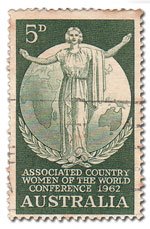
A friend and colleague Noric Dilanchian sent me photographs of two stamps from his collection and challenged me to write stories about them. This is the first story.

The pictured stamp celebrates the 1962 Associated Country Women of the World Conference.

The CWA is the oldest and largest organisation representing the interests of country women. The NSW and Queensland Branches of the CWA were formed in 1922, followed over the next fourteen years by each of the other states and the Northern Territory. A national association was formed in 1945.

Helen Townsend's book, Serving The Country: the history of the Country Women's Association in New South Wales (Doubleday) traces the history of the NSW Branch of the Association from its formation in 1922 through to 1988.

She points out that the public picture of life in country Australia in 1922 was dominated by men. There are glimpses of women, but the stereoptype of the outback wife was very much a background figure - "a stoic little woman, fighting behind her man through drought, flood, fire and economic hardship" (p1).

Helen also notes that most Australian's picture the country woman as the wife of a grazier or a wheat farmer. But country women also included the wives of shearers and farm labourers, small farmer's wives, village and town women, wives of railway workers, aboriginal women. Religions, beliefs, life experiences and standards of living varied tremendously, but all shared certain common problems.

Unlike New Zealand which quickly developed a relatively large number of larger urban centres with significant facilities, the Australian population was much more dispersed, even the larger country centres much smaller than their New Zealand equivalents. When David Drummond, the member for the Northern Tablelands, visited New Zealand in the 1920s he was astonished at the decentralised nature of the population, at the size of communities compared with New England.

Geoffrey Blainey suggested in Tyranny of Distance that this dispersed pattern was a natural outcome of Australia's geography. I have suggested that at least in New England's case, issues associated with the centralisation of economic and political power were important.

Whatever the reason, the dispersed population structures created specific problems for country women in New England and other parts of NSW. These problems were compounded by another feature, the very much larger number of small farms and small to very small farming and mining settlements then as compared to now.

This population structure meant that there were many women remote from each other on farms, others with at least female companionship nearby but distant from the nearest reasonable size town, still more distant from Sydney its greater facilities.

By 1922 cars had started to spread following the development of the cheap and durable Model T Ford by Henry Ford in 1909. In 1915 15,000 cars were imported, of which 10,000 were Model Ts. But while cars were spreading, ownership was limited, with most country families still relying on horses in one way or another over rutted country roads. Those needing to go beyond the nearest town to Sydney or Brisbane then faced a long train or sea trip.

Illness or accident were common, community support structures were limited, leaving women and children especially vulnerable. Helen Townsend quotes one farmer's plea from 1922: "My wife is dying before my eyes . . . . we can't get help for her. She won't leave me and the boys and take a spell in the city."

These needs drove the early founders of the CWA.

From Easter 1922 as branches formed across the state, members decided that they needed somewhere to meet. This lead to the progressive creation of CWA Rest Rooms, places where women could meet, have a cup of tea, feed babies. These Rest Rooms also became a valuable facility for community meetings. It is hard today to realise just how important all this was in days when a trip to town was a major all-day event, when basic facilities for women (men at least had the ubiquitous pub) were lacking.

The growing CWA also focused on health issues for women and children. Baby health centres were created, education programs developed, bush nurses and bush hospitals created. Holiday homes were established where country women could take breaks.

All this development had to be funded. CWA branches ran a variety of fund raising activities including catering for a variety of country and town events, in so doing adding further to the fabric of community life.

In all, the organisation was an enduring success. So, Noric, your stamp has given me an excuse to at least sketch another element in the New England experience.

Sunday, August 27, 2006

New England Australia - Writers and Writing Continued


Robert Drewe and Michael Sharkey, New England Regional Art Museum, photo New England Writers Centre.

I mentioned Michael Sharkey in New England Australia - Writers, my first post on New England writers. Michael has sent me a very kind email saying that he likes my new England site: "very classy."

I had not intended to run another immediate post on New England writers and writing, but Michael's email included some interesting material.

Michael pointed me to the AusLit data base, an electronic bibliographic database project currently maintained at the University of Queensland. I mention it here because while I did know it and had referenced it, it is a useful public data base, if most accessible to those in tertiary institutions. It requires a subscription for full access.

Michael also pointed me to another site, one that I knew nothing about, lyrikline, a German based poetry site. A German site? It is actually an international poetry site with poems in four languages. The site also includes poets reading their own poems, although for some reason I have yet to work out I could not download. Les Murray (and here), another New England poet, and Michael were the first Australians to be included.

Subsequently other Australians were included including Peter Skrzynecki, another writer with New England connections, teaching at at Jeogla on the Tablelands, Kunghar on the Tweed River. Peter also completed a BA plus a Master of Letters at the University of New England. You can find out more about Peter's fascinating history here.

Returning to Michael, I had forgotten that he was chair of the New England Writers Centre and had been so since its formal inception in 1993.

The Centre is actually an example of the two definitions of New England that I referred to in early posts, the New England Tablelands and North Western Slopes as compared to the broader New England area covered by the Northern or New England separation movements.

The New England Writers' Centre opened in 1994. Funded by the NSW Ministry for Arts and formally opened in 1964, the Centre is situated in Armidale but serves the New England Tablelands and Northern Slopes from Wee Waa in the west, Bellingen in the east, Tamworth in the south, and Tenterfield in the north.

The inclusion of Bellingen is interesting because the town is actually located on the Bellinger River in the humid coastal zone, not the Tablelands as such. However, Bellingen is only two hours (153 kilometers) away from Armidale and has become a significant centre for those seeking alternative life styles.

The Centre maintains an active program of activities using local writers, while also bringing the best external writers for readings, forums and workshops. The Centre's contact details are:PO Box 1219, Armidale NSW 2350, Email newc@northnet.com.au, Ph 02 6772 2710.

Friday, August 25, 2006

New England Australia - yet still more on writers and writing


When I began this blog I had a particular focus. I wanted to capture elements of New England that I feared were vanishing for ever. So my focus was on the past. But now that I am part way down track, I find an increasing emphasis on the present. This leads to a new focus, revealing to the different parts of New England what others are doing.

Sophie Masson (photograph) is one of New England's most popular writers. You can find her writings in most Australian book stores.

Sophie was born in Djakarta to French parents on 18 May 1959. She went to school in Sydney at Mount St Benedict College at the same time as my wife, then married and later moved to Armidale with her family for life style reasons. She is a prolific and well published writer with a focus on fantasy/history drawing on her mixed background.

This background is in fact a fascinating one. You can find out more details on Sophie's web site (here), but just to give you a teaser, Sophie writes:

"I don’t just dream fantasy and legend; I live it. Brought up in the cracks between cultures, in the midst of families whose storytelling was in their very blood and bones, whose imaginations could hardly keep up with their strange and extraordinary lives, I was surrounded as a child by amazing riches of experience."

Like Kardoorair Press in Armidale, Catchfirepress is a specialist New England publisher. Located in Newcastle and incorporated in October 1998, it aims to publish writers from the Hunter area in books wholly designed and illustrated there. Feel free to explore their web site; there they have all their books & pamphlets from 1998 through to the present.

This Is Not Art is held in Newcastle over the October long weekend each year and is Australia's premier independent arts and new media festival. This is not Art is dedicated to showcasing the work and ideas not included in other major festivals, highlighting major trends. This year's festival will be held from 28 September to 2 October.

Wednesday, August 23, 2006

New England, Australia - still more writers

Listening to ABC 702 in Sydney I discovered that Bob Herbert's play No Names ... No Pack Drill was being produced again. I was also fascinated to discover that Richard Glover had had a small cameo part in what I think was the first production of the play in Armidale in 1979.

John McCallum's review of the play in The Australian notes that this was already a nostalgic play when first produced. Set in 1942 when Sydney was awash with sailors, it tells the story of a young Australian war widow, Kathy, who harbours an American marine deserter, Rebel, and falls in love with him. The play is being produced by the NIDA Company, Parade Theatre, Sydney and is on until September 3.

I was in Canberra when the play was first produced, but remember reading about it in the Armidale Express. I was surprised at the time because I did not know that Bob was a writer. When my interest was triggered by the ABC story and I did some research on his life, I was surprised again simply because it showed me how little I knew.

Bob was born at Yea in Victoria on 6 April 1923. During the Second World War he served in the RAAF and the Second AIF. After the war he became a radio officer at sea where he began writing plays. Keen to pursue his interest in theatre, Bob moved to Queensland as an actor and radio station manager.

Bob came to Armidale as Theatres Manager at the University of New England. Here he played a key role in the development of theatre facilities and the provision of technical support for the University's Theatre Studies Department. Bob died in 1999.

Bob's story reminds me that there is still no history, or at least one that I am aware of, of theatre in New England. This is another significant gap in New England historiography, one that I will write about in another post to try to explain why I think it is important.

Returning to New England writers, in my post on the death of David Wright, I mentioned in passing the link between P A Wright and Earle Page. Page (and also here) was one of the pivotal figures in the history of New England in his own right and through his links with others.

Mentioning Page reminded me of another New England writer, Geoff Page, Earle Page's grandson, a writer also linked to a number of my recent stories.

Geoff was born in Grafton on 7 July 1940. Like Alex Buzo, he went to The Armidale School (TAS), in Geoff's case as a boarder. I have never discussed with Geoff where he got his love of English, so I am left wondering whether like Alex he acquired it at school or later while studying at the University of New England.

I first remember meeting Geoff while he was at University because he was courting the daughter of Professor Sommerville. Like my own father, Prof Sommerville had been one of the five original staff members appointed to the newly established New England University College in 1938. Malcolm and Paul, the Sommerville twins, were the same age as me and we were good friends.

In 1964, Geoff moved to Canberra where he taught in Canberra schools and was writer-in-residence at a number of academic institutions. At the end of 2001 he retired from being head of English at Narrabundah College, a position held since 1974.

Geoff has built up a considerable body of work over the years, publishing sixteen collections of poetry, two novels, three verse novels, anthologies, translations and a biography of the jazz musician Bernie McGann published in 1997 by Kardoorair Press, the Armidale publishing house I mentioned in my first post on New England writers. His works have been translated into a number of languages.

Geoff has won several awards, including the ACT Poetry Award, the Grace Leven Prize, the Queensland Premier’s Prize for Poetry and the 2001 Patrick White Literary Award.

Geoff also been active in the literary community, participating in poetry readings, seminars and conferences both in Australia and overseas. The last time I saw Geoff in fact was at a poetry reading in Canberra while I working there.

For those interested in more information, Geoff has his own web site.