Wednesday, July 26, 2006

New England Australia gorge country


In my last post I provided some references on the Country Party to support my historical analysis.

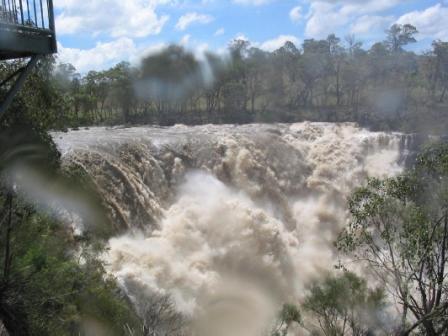
I was going to continue the historical theme, but an email from Nicole Payne (John Campbell Communication & Marketing - http://www.jccm.com.au/) reminded me that this blog is meant to be about the life and culture of New England, not just its history. Nicole's email contained some wonderful pictures of New England's gorge country plus some supporting information.

In previous posts (see Geography of New England: overview, Geography of New England: impact of Great Diving Range) I have spoken about the region's geography and especially the impact of the the Great Dividing Range and its rugged eastern edge on New England's life and history.

The fast flowing coastal rivers have cut huge gorges through the escarpment, some stretching into the centre of the New England Tablelands. This creates a varied mix of spectacular country including major national parks running from the Barrington Tops in the south up to the Queensland border.

These parks can be accessed from either the coastal valleys or from the various Tablelands cities and towns. Each place offers access to different types of spectacular country.

There is not space in this entry to provide complete information - that deserves a number of entries. However, two examples will give an initial taste.

At Walcha on the Southern New England Tablelands, Oxley Explorer offers tours using "okas", 4WD vehicles seating up to 13 people, of some of the most spectacular of the gorges east of Walcha including the Apsley Gorge of the World Heritage listed Oxley Wild Rivers National Park.

Sixty four kilometres north of Walcha, the Central Tablelands city of Armidale offers access to another set of gorges. There Fleet Helicopters offers a number of helicopter tours across the local gorge country.

This includes Heli Adventure transport, a specialised service for independent travellers and groups who want to be dropped into rugged and wild country. Fleet Helicopters can provide transport, food and equipment drops for camping, hiking, rock climbing, mountain biking, kayaking and fishing.

Friday, July 21, 2006

Country Party - annotated bibliography

As foreshadowed in my post of Friday 14 July 06 (The past is always present: the Country Party continued), this post provides some references on the Country Party for those interested in reading further.

I recognise that accessing some of the references may not be easy. Fashions change, and many are now long out of print.
  • Aitkin, D A, The Colonel: A Political Biography of Sir Michael Bruxner, Australian National University Press, Canberra 1969. Bruxner was one of the founders of the NSW Country Party and its leader for many years. A good read.
  • Aitkin, D A, The Country Party in New South Wales. A study of organisation and survival, Australian National University Press, Canberra 1972. An interesting book for all those interested in the study of politics.
  • Bayley, W A, History of the Farmers and Settlers Association of NSW, Farmers and Settlers Association, Sydney 1957. Bit of a pot boiler, but provides some insight into one of the founder organisations of the NSW Country Party.
  • Belshaw, J D, David Henry Drummond 1890-1930: The formative years, Armidale and District Historical Society Journal and Proceedings, No 22, March 1979, pp19-42. Drummond was one of the founders of the NSW Country Party.
  • Belshaw, J D, Journalist, Political Agitator and Theorist, Public Servant and Historian - and obituary of Ulrich Ellis, Armidale and District Historical Society Journal and Proceedings, No 25, March 1982, 99147-160. Ellis was a fascinating man who devoted much of his career to the Country Party and New State Movement.
  • Davey, Paul, The Progressive, Country and National Party in NSW 1919 to 2006, Federation Press, Sydney 2006. I have yet to read Paul's book.
  • Ellis, U R, The Country Party: A Political and Social History of the Party in New South Wales, F W Cheshire, Melbourne, 1958. This and the following reference on the Australian Country Party are written from the perspective of the involved insider.
  • Ellis, U R, A History of the Australian Country Party, Melbourne University Press, Parkville, 1963.
  • Graham B D, The Formation of the Australian Country Parties, Australian National University Press, Canberra, 1966. An interesting book because it draws out clearly the diferences between the various state parties and the reasons for those differences.
  • Harman, G S, Graziers in Politics: The Pressure Group Behavious of the Graziers' Association of New South Wales, PhD thesis, Australian National University, 1968. A study of the second major founder (and funder) of the Country Party in NSW.
  • Page, E, Truant Surgeon, Angus and Robertson, Sydney 1963. Biography of one of the Party's founders.

Tuesday, July 18, 2006

Wool in New England - an aside

Over the last week I have been putting up a story on the Regional Living Australia site focused on exploring the wool track across New England - http://www.regionalliving.com.au/index.cfm?p=2381.

Using a mix of text, photos and URLs I have tried to link the history of wool with communities and attractions across New England to help people explore the New England wool track. I hope that this will help bring this element of New England's history alive.

Thursday, July 13, 2006

The past is always present: the Country Party continued

In my post of Friday 7 July I began looking at the Country Party in New England, the second of the major political parties in New England during the twentieth century. This followed a brief post on the Labor Party.

Just to summarise and restate.

If we look at the New England electorates, state and Federal, over most of the twentieth century we find Labor Party dominance in the industrial electorates around Newcastle, Country Party dominance elsewhere in New England. I also suggested that the past was always with us, even if we did not always recognise it. A key point here is that a knowledge of the past helps explain current developments, including differences in patterns between areas.

In this context, I pointed to the way in which conservative grazing and more radical farming interests combined to form the Country Party in NSW. Of itself, this made the NSW Party more conservative than some other Country Parties and especially the Victorian Party which was dominated by radical and populist small farmers.

I also pointed to the way in which New England's geography allowed the Country Party in New England to combine mixed farming and grazing interests into a large compact block of seats spanning different primary producing areas, In turn, this helped draw in town elites, making the Party the dominant non-Labor Party in New England outside Newcastle.

This was not the case elsewhere in country NSW. There different geography combined with religous differences (the higher proportion of Irish Catholics more inclined to support Labor) prevented the new Country Party from establishing a dominant position. This made it easier for Labor to win seats, easier for the varying city based non-labor parties to gain a position. This created an electoral pattern in NSW in which Country Party support across the rest of NSW rose and fell with electoral tides while generally holding firm in New England.

The importance to the Country Party in New England of its capacity to combine interests and continue its dominance of local leadership was dramtically illustrated in 1941.

Following resolution of the turmoil of the Lang years, NSW Labor made a conscious and succesful effort to target leaders in country NSW, recruiting as candidates just those people who would have stood as Country Party candidates. This led to a major victory in the 1941 NSW elections in which Labor penetrated even New England areas that had been previous Country Party heartland.

Before carrying this story forward further, I need to outline the history of the New England New State Movement in the twentieth century since this is inextricably linked to the rise and later decline of the Country Party. We also need to look at the history and role of the media in New England and especially the newspaper press.

Before doing so, I will provide some references on the history of the Country Party in my next post.